Astronomers Stunned Again by Eta Carinae – the Star That Will Not Die
Astronomers Uncover Clues to the Star that Wouldn't Die
Data obtained by a clever technique that tin discover lite echoes hint at why Eta Carinae, the most luminous and massive star in the Milky Way, erupted similar a supernova, yet survived.
Space Telescope Scientific discipline Constitute/University Communications
Aug. three, 2018
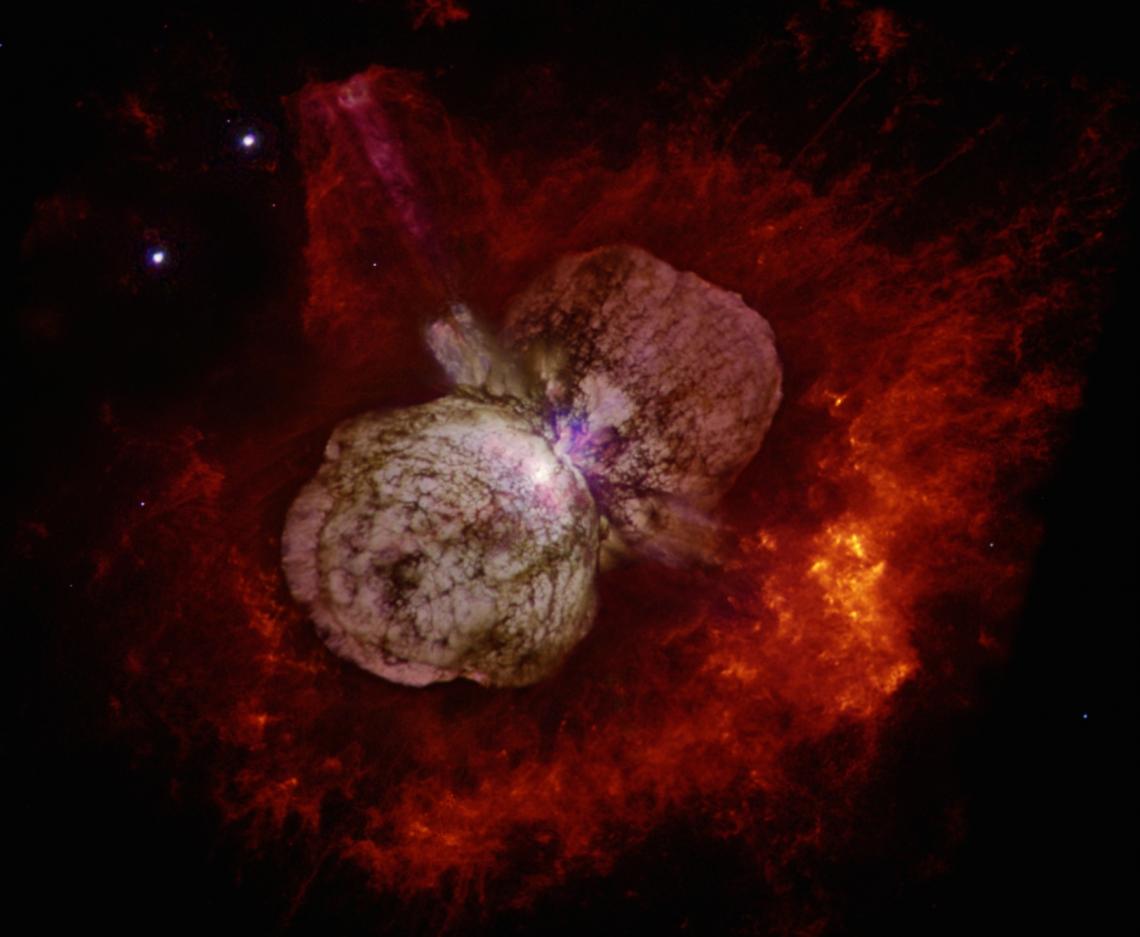
What happens when a star behaves like information technology exploded, merely information technology'southward yet there? About 170 years ago, astronomers witnessed a major outburst past Eta Carinae, the brightest known star in our Milky Style galaxy. The blast unleashed almost equally much energy equally a standard supernova explosion.
Yet, Eta Carinae survived.
An caption for the eruption has eluded astrophysicists. They tin't have a time machine back to the mid-1800s to observe the flare-up with modern technology. However, astronomers tin can employ nature's ain "time auto," courtesy of the fact that calorie-free travels at a finite speed through infinite. Rather than heading direct toward Globe, some of the calorie-free from the outburst rebounded or "echoed" off of interstellar dust, and is just now arriving at Earth. This consequence is chosen a low-cal echo. The light is behaving like a postcard that got lost in the mail and is only arriving 170 years later.
By performing modernistic astronomical forensics of the reflected light from the boom, researchers have concluded that the 1840s eruption may have been triggered by a prolonged stellar brawl among three rowdy sibling stars.
This tussle may have culminated with a trigger-happy explosion when Eta Carinae devoured one of its companions, rocketing more than x times the mass of our Sun into space. This ejected mass created two gigantic bipolar lobes resembling a dumbbell shape that is seen in present-day images.The surprise is that new measurements of the 19th century eruption reveal material expanding with record-breaking speeds of upwards to twenty times faster than astronomers had expected. The observed speeds are more like the fastest material ejected by the nail wave in a supernova explosion, rather than the relatively slow and gentle winds expected from massive stars before they die.
The results are reported in a pair of papers by a team led past Nathan Smith of the University of Arizona's Steward Observatory and Armin Rest of the Space Telescope Science Establish in Baltimore, Maryland. "Exceptionally fast ejecta seen in light echoes of Eta Carinae's Great Eruption" was published first, followed by "Low-cal-echoes from the plateau in Eta Carinae'south Keen Eruption reveal a two-stage shock-powered event." Both were published in Monthly Notices of the Royal Astronomical Society.
The low-cal echoes were detected in visible-lite images obtained since 2003 with moderate-sized telescopes at the Cerro Tololo Inter-American Observatory in Chile. Using larger telescopes at the Magellan Observatory and the Gemini S Observatory, both located in Chile, the team then used spectroscopy to dissect the light, allowing them to measure the ejecta's expansion speeds. They clocked material zipping forth at more than 20 million miles per hr — fast enough to travel from Earth to Pluto in a few days.
The observations offer new clues to the mystery surrounding the titanic earthquake that made Eta Carinae the second-brightest night star in the sky, as seen between 1837 and 1858. The new data hint at how it may have come up to be the most luminous and massive star in the Galaxy galaxy.
"We see these really high velocities in a star that seems to have had a powerful explosion, but somehow the star survived," Smith explained. "The easiest way to do this is with a stupor wave that exits the star and accelerates material to very high speeds."
Massive stars normally encounter their terminal demise in stupor-driven events when their cores plummet to brand a neutron star or black hole. Astronomers see this miracle in supernova explosions where the star is obliterated. So how do you accept a star explode with a stupor-driven event but non have information technology completely blow itself apart? Some vehement event must have dumped the right amount of energy onto the star. The energy was also much for the star to concord onto and it ejected its outer layers.
One possibility for just such an result is a merger between ii stars, but it has been hard to notice a scenario that could work and lucifer all the data on Eta Carinae. The researchers suggest that the most straightforward way to explicate a wide range of observed facts surrounding the eruption is with an interaction of 3 stars, where the objects accept exchanged mass.
If that's the case, then the present-twenty-four hour period binary system must have started out as a triple organization.
"If we merged two stars and we're left with two, there must have been three to brainstorm with," Smith said. "The reason why nosotros have this crazy triple arrangement that interacts is considering we need an caption for how the present-twenty-four hours companion rapidly lost its outer layers before its more massive sibling."
In the team'southward proposed scenario, two hefty stars are orbiting closely and a third companion is orbiting farther away. When the most massive of the close binary stars nears the terminate of its life, it begins to expand and dumps most of its material onto its slightly smaller sibling.
The sibling has now bulked up to about 100 times the mass of our Dominicus and is extremely brilliant. The donor star has been stripped of its hydrogen layers, exposing its hot helium core. Hot helium core stars are known to correspond an advanced stage of evolution in the lives of massive stars.
"From stellar development, at that place's a pretty firm agreement that more massive stars live their lives more than chop-chop and less massive stars have longer lifetimes," Remainder explained. "So the hot companion star seems to be further along in its evolution, even though it's a much less massive star than the i information technology is orbiting. That doesn't make sense without a transfer of mass."
The mass transfer also alters the gravitational residual of the arrangement, and the helium-cadre star moves farther away from its monster sibling. As a consequence of this widening separation, the helium-core star interacts gravitationally with the outermost star, pulling information technology into the fray. The ii stars trade places, and the outermost star gets kicked inwards. Information technology makes a few close passes, interacting with its heavyweight partner earlier the two stars merge. That merger process involves a spiraling-in phase that lasts many decades, during which fourth dimension the 2 stars may have been inside a bloated common envelope or cocoon of mass effectually the merging organisation.
In the outburst's initial stages, the ejecta was dumbo and expanding relatively slowly as the two stars spiraled closer and closer. Afterwards, an explosive event occurred when the ii inner stars finally merged together, blasting off material moving 100 times faster. This material eventually caught up with the slow ejecta and rammed into information technology like a snowplow, heating the textile and making it glow. This glowing material was the lite source of the primary historical eruption seen by astronomers a century and a half agone.
Meanwhile, the surviving companion settles into an elongated orbit around the merged monster star, leaving the binary organisation that is seen today. Astronomers cannot clearly see the companion because it is lost in the glare of its much brighter partner. However, they can detect the companion's presence every five.5 years when it passes through the behemothic star'due south outer envelope, producing stupor waves that are detected in X-rays. A amend understanding of the physics of Eta Carinae'south eruption may assistance to shed light on the complicated interactions of binary and multiple stars, which are critical for understanding the evolution and death of massive stars.
The Eta Carinae system resides seven,500 lite-years away inside the Carina nebula, a vast star-forming region seen in the southern sky. The team'southward findings will exist published in two papers in The Monthly Notices of the Majestic Astronomical Order.
The Hubble Space Telescope is a projection of international cooperation between NASA and the European Space Agency. NASA'south Goddard Space Flight Center in Greenbelt, Maryland, manages the telescope. The Space Telescope Science Institute (STScI) in Baltimore, Maryland, conducts Hubble science operations. STScI is operated for NASA past the Clan of Universities for Research in Astronomy in Washington, D.C.
Actress info
Share
Source: https://news.arizona.edu/story/astronomers-uncover-clues-star-wouldnt-die
0 Response to "Astronomers Stunned Again by Eta Carinae – the Star That Will Not Die"
Enregistrer un commentaire